
A tire that needs air every few days is not just inconvenient. It is a warning that can turn a normal Denver commute, school pickup, or jobsite stop into a flat-tire interruption. Knowing how to find a tire leak early helps protect your tire, wheel, fuel economy, and safety – often before the problem leaves you stranded.
A slow leak can come from a tiny tread puncture, a damaged valve stem, a poor tire-to-wheel seal, or even a wheel that has been bent by a pothole. The right test depends on where the air is escaping. Start with a careful inspection, but do not ignore a tire that repeatedly loses pressure even when you cannot see an obvious cause.
Start by Confirming the Tire Is Actually Leaking
Temperature changes affect tire pressure, especially during Colorado’s colder months. A drop of a few PSI across several tires after a sharp weather change may be normal. One tire that consistently drops faster than the others is different. That pattern usually points to a leak.
Check pressure when the tires are cold, meaning the vehicle has been parked for at least three hours or driven less than a mile. Use a reliable tire gauge and compare the reading to the pressure listed on the driver’s door-jamb placard. Do not use the maximum PSI molded into the tire sidewall as your target pressure.
Inflate the tire to the vehicle manufacturer’s recommended pressure and record the reading. Check it again the next day, then after a few days. If it loses several PSI, inspect it promptly. Driving on an underinflated tire generates excess heat, affects handling, and can damage the tire internally even if it still appears usable from the outside.
How to Find a Tire Leak With a Visual Inspection
Park on level ground in a well-lit location. If possible, turn the steering wheel so you can see more of the front tire tread and sidewall. Inspect both sides of each tire, including the inner sidewall, which is easy to miss.
Look closely for nails, screws, staples, bits of wire, or sharp debris in the tread. Do not pull out an object that is still embedded. It may be slowing the leak, and removing it can cause the tire to lose air rapidly. Mark the location with chalk or a small piece of tape on the sidewall, then arrange for a professional inspection.
Also check for cuts, bulges, cracks, and scuffs along the sidewall. A sidewall puncture or damage near the shoulder of the tire is generally not safely repairable. A professional technician should evaluate it rather than attempting a plug or sealant repair.
Pay attention to uneven wear as well. A tire worn heavily on one edge may have an alignment, suspension, or inflation issue that contributes to poor performance. While uneven wear does not itself prove an air leak, it can reveal why a tire is more vulnerable to damage.
Use Soapy Water to Locate Small Air Leaks
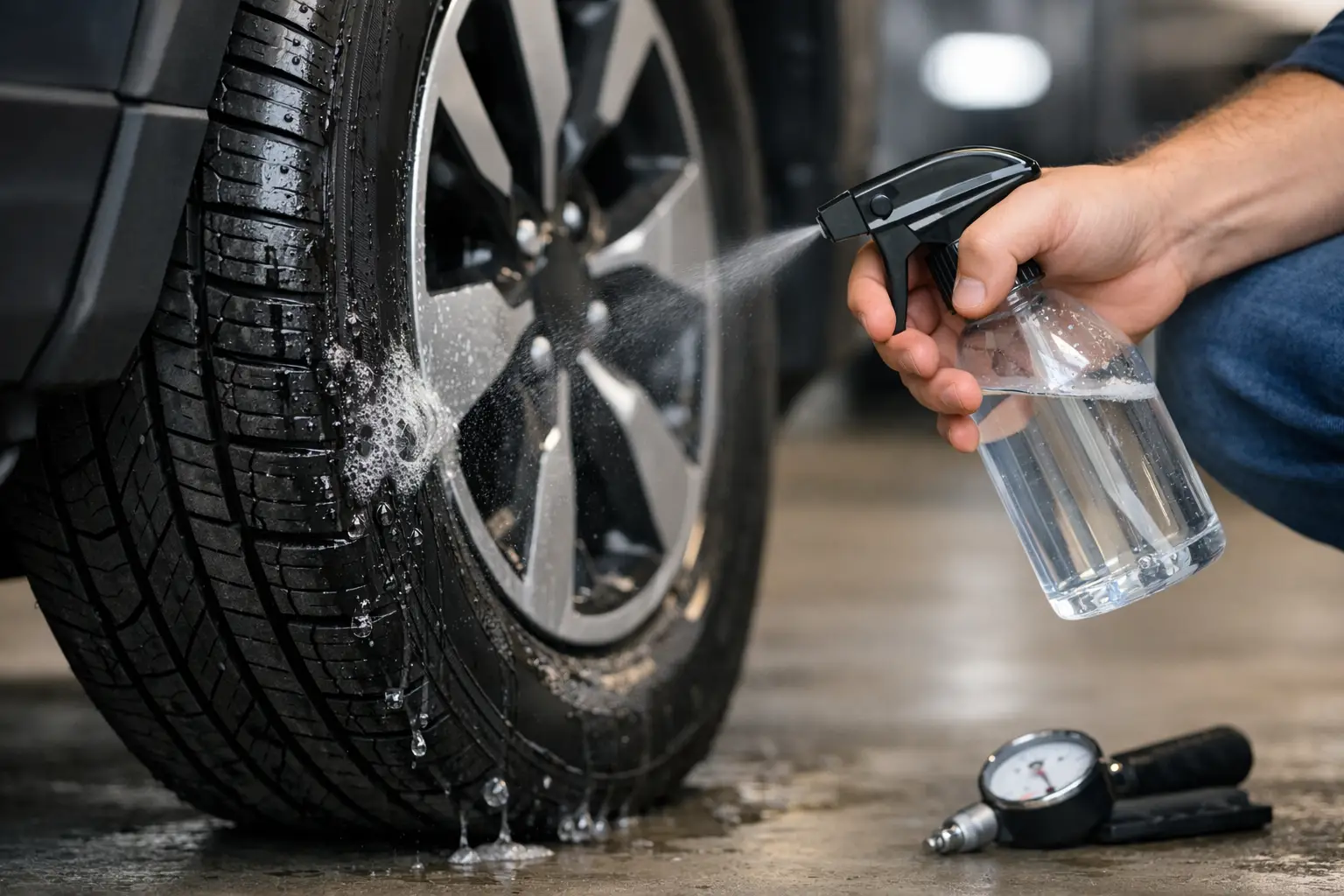
The simplest at-home method is a soap-and-water test. Mix water with a small amount of dish soap in a spray bottle, then inflate the tire to the recommended cold pressure. Spray the solution over likely leak points and watch for bubbles that grow or continue forming.
Check these areas carefully:
- The tread surface, especially around any embedded debris
- The valve stem and the base where it meets the wheel
- The valve core inside the stem
- The tire bead, where the tire seals against the wheel rim
- Any visible wheel damage, corrosion, or previous repair area
Steady bubbles identify the leak location. Small foam bubbles that remain still after spraying are not necessarily a problem. You are looking for bubbles that actively expand as air pushes through the opening.
A tread puncture may produce bubbles slowly, particularly if the nail or screw is still in place. Rotate the tire slightly and repeat the test if you cannot see every part of the tread. Never crawl beneath a vehicle supported only by a jack to inspect the tire. If the area is difficult to access, a mobile tire technician can safely raise the vehicle with professional-grade equipment and inspect the full tire and wheel assembly.
Check the Valve Stem, Valve Core, and TPMS Seal
Valve-related leaks are common, inexpensive to overlook, and often easy to confirm. Spray soapy water directly over the valve cap area. If bubbles appear at the center pin, the valve core may be loose or worn. If bubbles form around the base of the stem, the rubber stem or its seal may be cracked, aged, or damaged.
Vehicles with tire pressure monitoring systems may use specialized valve stems and sealing components. Corrosion around a metal TPMS valve stem can compromise the seal, especially after years of road salt, moisture, and seasonal temperature changes. Replacing a valve component may require proper TPMS service procedures so the sensor is not damaged and the system continues to report accurately.
A TPMS warning light tells you that one or more tires are low, but it does not diagnose the source of the leak. Treat it as an early warning, not a reason to keep adding air without finding the cause.
Inspect the Wheel Bead and Rim Condition
If the tread and valve stem pass the soap test, focus on the bead seal. The bead is the airtight contact point between the tire and the wheel. Corrosion, dirt, old tire sealant, or a bent wheel can create a small gap that allows air to escape.
This type of leak is more common on older wheels and can be difficult to see without removing the tire. You may notice it after a pothole strike, curb contact, or seasonal tire change. A wheel can look mostly normal while still being bent enough to affect the bead seal.
Professional diagnosis matters here. The tire generally needs to be removed so the technician can inspect the bead, clean corrosion from the wheel mating surface, check for cracks, and determine whether the wheel is repairable. Simply adding sealant may temporarily slow the leak but can make a proper repair messier and may interfere with TPMS components.
Know When a Tire Can Be Repaired
Not every tire leak requires replacement. Many small punctures in the center portion of the tread can be professionally repaired if the tire was not driven underinflated and the puncture meets repair guidelines. A proper repair usually involves removing the tire, inspecting the inside, and installing a combination patch-and-plug repair from the interior.
External plugs can be useful as an emergency measure in limited circumstances, but they do not allow an internal inspection. They are not the same as a complete professional repair. The trade-off is simple: a quick temporary fix may get you moving, but it cannot confirm whether the tire has internal damage.
Replacement is often the safer path when the damage is in the sidewall or shoulder, when there are multiple close punctures, when the hole is too large, or when the tire was driven while very low on air. A technician should also check the tire’s age, tread depth, and overall condition before recommending a repair.
Avoid These Common Mistakes
Do not keep inflating the same tire week after week and assume the issue is minor. Slow leaks can become fast leaks without warning. Avoid tire sealants unless there is no safer option to get out of an immediate situation. Many sealants are messy, can complicate tire repairs, and may affect TPMS service.
Do not rely on visual inspection alone. A nail can enter at an angle and hide in a tread groove, while a bead leak may have no visible sign at all. And never drive far on a tire that is significantly underinflated or visibly low. If the sidewall has flexed excessively, internal damage may already be present.
For Denver drivers who do not have time to visit a shop, Tires Xpress can inspect a suspected leak at your driveway, office, parking lot, or fleet location. A trained mobile technician can identify whether the problem is a repairable puncture, valve issue, wheel seal concern, or tire damage that calls for replacement.
The best time to address a tire leak is when it is still a small pressure loss on your schedule. Check the tire, document what you find, keep it properly inflated, and have it professionally evaluated before the next low-pressure warning becomes a roadside flat.