
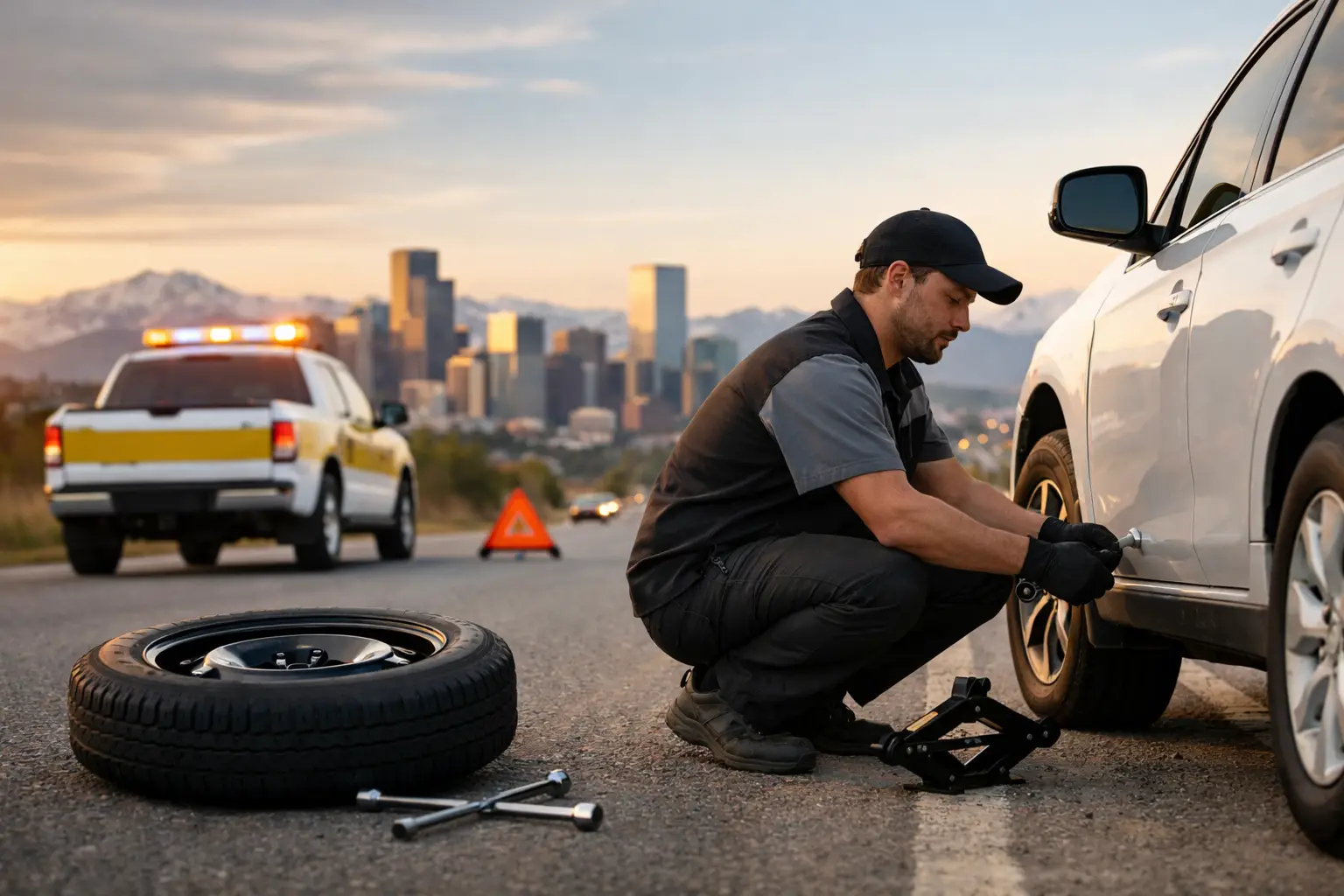
A flat tire can turn a normal Denver drive into a stressful stop in minutes. Whether you are leaving downtown after work, picking up children from school, parked at an office, or headed through changing Front Range weather, a roadside tire change in Denver should begin with one priority: getting yourself out of danger before worrying about the wheel.
A spare tire and a lug wrench can solve some situations. But they are not the best answer for every vehicle, every location, or every tire problem. Modern vehicles may have no spare at all, a compact spare with strict speed limits, wheel locks, low-profile tires, or TPMS sensors that need careful handling. Professional mobile tire service brings the equipment and tire-shop standards to your location, so you can make the safe choice without adding a tow truck, a shop wait, and a disrupted day.
Start With Safety, Not the Tire
If a tire fails while you are driving, avoid sudden braking or sharp steering. Ease off the accelerator, maintain a steady grip, and move toward a safe place to stop. A parking lot, wide shoulder, or quiet side street is far better than stopping in an active travel lane.
Turn on your hazard lights and park on firm, level ground whenever possible. Set the parking brake and keep passengers away from traffic. If you are on a narrow highway shoulder, near fast-moving traffic, on a blind curve, or in a location where a service vehicle cannot safely work, do not attempt a tire change yourself. Move to a safer area if the vehicle is still controllable, or request roadside assistance and follow local emergency guidance.
Denver weather adds another variable. Snow, ice, rain, high winds, and sudden temperature changes can reduce traction and make a roadside stop more hazardous. A tire that was only slightly low in the morning can become a more obvious problem after a cold-weather pressure drop. Give yourself room, visibility, and time before deciding what happens next.
When a Roadside Tire Change in Denver Makes Sense
A wheel change is often the right immediate response when a tire has a major puncture, sidewall damage, a blowout, or a leak that cannot be safely inflated long enough to reach service. It can also help when a tire has separated, gone flat after hitting a pothole, or sustained damage from road debris.
Still, replacing the wheel is only the first decision. The condition of the failed tire determines what should happen afterward. A puncture in the central tread area may be repairable if it is small, the tire was not driven flat, and the internal structure has not been damaged. A puncture near the shoulder or sidewall is usually not repairable. Sidewall cuts, bulges, exposed cords, and damage from driving on a deflated tire generally call for replacement.
That distinction matters because a compact spare is designed to get you to the next step, not to become a long-term tire. It may have lower speed and distance limits, reduced traction, and a different diameter from the other tires. On an all-wheel-drive vehicle, significant tire-size differences can also put unnecessary strain on the drivetrain. If you are unsure whether a spare is appropriate, it is worth getting a professional assessment at the vehicle rather than guessing.
Why Changing a Tire Yourself Is Not Always the Fast Option
The traditional roadside tire change sounds simple: jack up the car, remove the lug nuts, install the spare, and drive away. In practice, a number of things can slow the process or create a safety issue. Lug nuts may be overtightened, corroded, or protected by a missing wheel-lock key. The factory jack may be difficult to position safely. Soft pavement, gravel, sloped ground, snow, or uneven curbs can make lifting the vehicle risky.
There is also the question of torque. Lug nuts need to be tightened in the correct sequence and to the manufacturer’s specified torque. Too loose, and the wheel can move or loosen. Too tight, and studs, nuts, or brake components can be damaged. An impact tool alone is not a final torque setting.
Professional mobile technicians use appropriate hydraulic lifting equipment, precision torque wrenches, portable air compressors, tire repair tools, and inspection equipment. When the job involves a new tire rather than a spare, the service should also include proper mounting, balancing, inflation, valve-stem inspection, and TPMS handling. Those details protect ride quality, tire life, and vehicle safety after the technician leaves.
What to Check Before Calling for Help
You do not need to diagnose the tire perfectly. A few clear details help a mobile tire provider arrive prepared and help you understand whether a repair, spare installation, or replacement is likely.
First, note your exact location and whether the vehicle is in a driveway, parking garage, office lot, curbside space, or roadside shoulder. Mention clearance concerns, such as a low garage ceiling or a blocked parking area. Then look for visible clues without putting yourself at risk: a nail or screw in the tread, a split sidewall, a bent wheel, or a tire that has come off the bead.
Have your vehicle year, make, model, and tire size available if possible. The tire size is printed on the sidewall and usually follows a format such as 225/65R17. If you have a spare, tell the technician whether it is a full-size spare, compact spare, or unknown. It is also helpful to mention warning lights, especially a low-pressure or TPMS warning.
Avoid pulling out a nail or screw before the tire is inspected. The object may be temporarily limiting the air loss. Avoid using tire sealant unless it is specifically appropriate for your vehicle and situation, too. Sealant can complicate repair, interfere with TPMS components, and create extra cleanup inside the tire.
Mobile Tire Service Brings the Shop to the Stop
For many drivers, the best outcome is not simply getting rolling again. It is resolving the tire issue where the vehicle already sits. That may mean repairing an eligible puncture in your office parking lot, installing a replacement tire at home, changing to seasonal tires in your driveway, or fitting a spare while a replacement is arranged.
Tires Xpress is built around that convenience without cutting corners on the work. Owner/operator technicians arrive in custom-equipped service rigs with professional-grade mounting, balancing, inflation, inspection, torque, and TPMS equipment. The goal is to eliminate the usual chain of events after a flat: waiting for a tow, finding a ride, sitting in a service lobby, and returning later for the vehicle.
Same-day availability can be especially valuable when a tire issue interrupts work, travel, or family plans. For customers planning ahead, mobile service also makes routine tire rotation, seasonal changes, and new tire installation easier to fit around a full schedule. For fleet operators, responsive support helps keep revenue-producing vehicles moving and reduces downtime that can spread across an entire day.
Repair, Replace, or Install the Spare?
The right service depends on the damage, the tire’s remaining tread, and how the vehicle is used. A safe tread-area repair may be the most efficient and economical option when the tire has good remaining life. If the tire is worn near its replacement point, has sidewall damage, or has been driven while flat, replacement is usually the smarter decision.
Replacing one tire can involve trade-offs, particularly on all-wheel-drive vehicles. Depending on manufacturer guidance and tread-depth differences, matching the remaining tires may be necessary to maintain consistent rolling circumference. A technician can measure tread depth and explain whether one tire, a pair, or a full set is the appropriate recommendation.
If your immediate need is a spare installation, treat it as a temporary solution unless it is a full-size, matching spare. Follow the speed and mileage guidance on the spare tire, keep an eye on pressure, and schedule the permanent repair or replacement promptly. A spare gets you out of the immediate problem. Proper tire service gets you back to normal driving.
Keep the Next Flat From Taking Over Your Day
Tire problems cannot always be prevented, especially with Denver potholes, construction debris, and changing temperatures. Regular pressure checks, tread inspections, and tire rotations reduce the odds of an unexpected failure and help you catch slow leaks before they become a roadside stop.
If your TPMS light comes on, do not assume it is only a seasonal pressure change. Check the pressure against the driver-door placard, not the maximum pressure printed on the tire sidewall. If the light returns after inflation, you may have a puncture, leaking valve stem, wheel damage, or a sensor concern that deserves attention.
A flat tire is disruptive enough. The right response should be safe, clear, and built around getting your schedule moving again. When you need help at the curb, in a parking lot, or at home, choose service that treats the tire and the time you have already lost with equal care.